


Mehmet Özay 11.10.2010
Myanmar held its first political elections in two decades on Sunday, November 7. As predicted by international circles before the elections, this 'democratic' initiative is far from being a free and fair election. It was US President Obama who declared to the world community that the elections did not take place under fair and equal conditions.
The first election in two decades under the political dominance of Southeast Asia's Buddhist military junta regime, which the West, especially the United States, does not recognize and therefore refers to as Burma instead of Myanmar, is expected to result in the party that is the political extension of that regime winning the majority of the votes.
The political struggle with the current junta regime goes back two decades. Aung San Suu Kyi, the country's leading democracy fighter and leader of the National League for Democracy, decided to boycott the elections based on her experience twenty years ago, foreseeing what would happen after the elections. Although Aung has persevered against the military junta that has been in power since 1962, he has not achieved political success. In the last elections held in 1990, he received enough votes to win a parliamentary majority, but the junta refused to allow a change in the system and has kept Aung in detention ever since. The irony of the so-called democratic elections was that, after the leading opposition movement decided to boycott the elections, the race was between the former military dictators and the political tool of the current regime. The former dictators, united under the umbrella of the National Unity Party and led by Ne Win, are competing against the new dictatorial regime supporters represented in the USDP.
On the other hand, time will tell what the elections, in which more than thirty parties are said to be participating, will bring and take away from the country. However, experts say that the junta does not intend to give up the job so easily. That is why it is certain that the junta supporters in civilian guise will gain the majority in the parliament. Where do the Rohingya Muslims stand in this picture? In this context, we had a brief interview with Chris Lewa, the leading representative of the Rohingya platform, who works with Rohingya Muslims in Myanmar's northern Rakhine State and especially in refugee camps in Bangladesh, to get accurate information about the election results and to get their opinions. Lewa argues that Arakanese were given the opportunity to vote and form political parties in the elections, but the USDP, which is supported by the junta regime across the country, rigged the elections. Western non-governmental organizations and political observers are of the same opinion. Lewa said that no information on vote counts has been released yet, and that despite all the undemocratic interference, the Arakanese-led National Democratic Party for Democracy (NDPD) will win the majority in Arakan State. Lewa is not optimistic that these elections will change the fate of the Arakanese Muslim minority, at least for the foreseeable future, but he considers it a victory that the Muslim minority will be represented in the new parliament.
What does this election in Myanmar signal? First, it is a well-known fact that the US and ASEAN countries are uncomfortable with the existence of such a junta regime in Southeast Asia in today's world. The recent developments that led Western and ASEAN countries to turn their attention to this country were the violent suppression of the so-called Saffron Revolution in September 2007, when thousands of Buddhist monks participated in demonstrations against the current regime. This was followed by the dumping of thousands of Arakanese Muslims into the ocean, first by Myanmar and then by Thailand. We will discuss this in detail below.
First of all, there is no doubt that a dictatorial country in ASEAN has a negative impact on the very existence of this regional political and economic organization. Many scholars agree that Susilo Bambang Yudhoyono, who has been in power since 2004 in Indonesia, a former dictatorial country still undergoing a reform process, has shown a particular interest in Myanmar, especially during his second term as president. Following US and ASEAN initiatives, the United States and ASEAN have pressed for the release of detained democracy movement leader Aung San Suu Kyi, 65, and for a democratic transition in the country. If the news that Aung will be released in the middle of this month proves to be true, various circles will naturally conclude that the above efforts have worked. How this will affect the country's democracy and Aung's place in the new political arena is another important question.
It is certain that the solution to the chronic problem in Myanmar in areas such as human rights, minorities and democracy cannot be left to the mercy of the junta. Although ASEAN, which is composed of the countries of the region, is expected to fulfill an important function in solving this problem, it is necessary to ask how many countries within the union are clean in terms of "political honor". On the other hand, the US, which distributes democracy and freedom to the world, does not seem to be able to defeat Myanmar, which has been under an embargo for the last ten years. While the solution to the country's chronic social and political problems depends primarily on the junta regime's "loosening its ranks", it is noteworthy that the most important support in this regard comes from its neighbor and supporter China. In other words, China has the potential to implement a policy that can bring Myanmar to its knees. The question is whether China has the will to do so. Can care be expected from Islamic countries in this context? We will have the opportunity to address this in the rest of the article.
Under these circumstances, it seems that ending the junta regime in Myanmar is serious enough to require the mobilization of a global alliance. It seems plausible that leading Muslim countries can at least spearhead this initiative by mobilizing international organizations. It is time for Turkey, which has gained a significant credibility with the European Union, the UN and Islamic countries, to take initiatives to liberate Muslims in this corner of Southeast Asia from the inhumane practices they have been subjected to for decades. The Western media, as well as certain circles with political and academic identities, keep the issues of Islamist terrorism and Islamophobia on the world agenda, and in return
In the 21st century, when some Islamic circles allocate huge sums of money for counter-initiatives, the existence of communities that are still subjected to inhumane oppression is a source of shame for people with an understanding of Islam.
In the 21st century, when some Islamic circles allocate huge sums of money for counter-initiatives, the existence of communities that are still subjected to inhumane oppression is a source of shame for people with an understanding of Islam.
It would be an expression of historical continuity to expect Turkey to take the lead in ensuring that the masses under the oppression of dictatorial regimes, regardless of religion or race, are given the right to live humanely. We leave the answer to the question "Does Turkey have this power?" to the actors in power.
Myanmar and Muslims
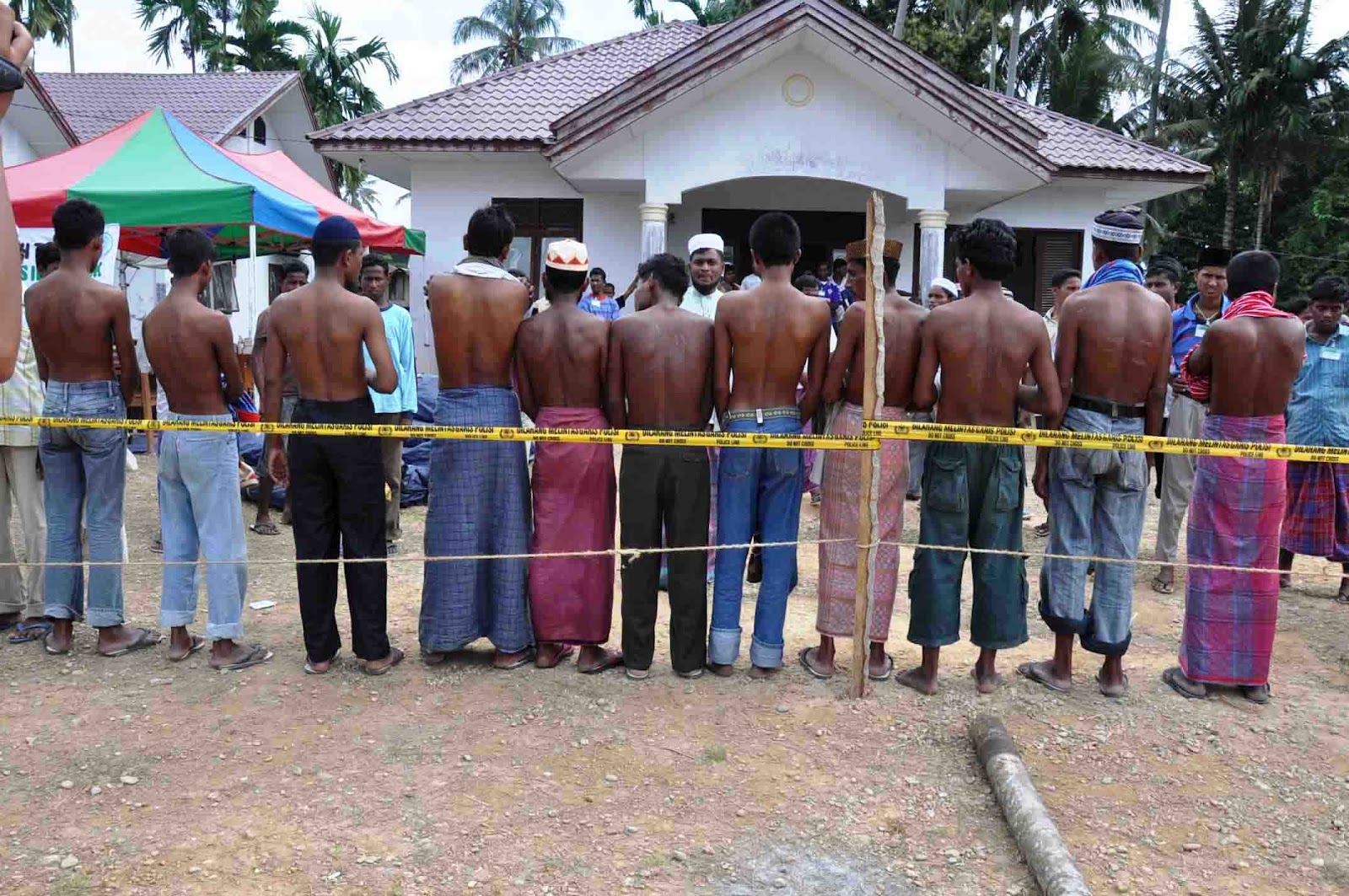 |
| Some of the tortured Arakanese are guests in Aceh |
Myanmar is known for its population of 53 million and its pluralistic ethnic structure. Most of the population is Buddhist. The country has been ruled under the dictatorship of a Buddhist military regime since the 1970s. The fact that Buddhism, which has the image of a religion that is integrated with nature, let alone humans, in the world's spectrum of religions, has produced such a dictatorial regime is a research topic in itself.
Since the 1970s, the Myanmar government has continued its campaign of repression and intimidation against various religious and ethnic minorities other than Buddhists. Religious minorities, including Muslims, face forced conversion to Buddhism and thus Burmeseization. The presence of over one million Arakanese Muslims in Thailand alone is a clear indication of this. In Malaysia, they are estimated to number around twenty thousand. Neighboring Bangladesh, a member of the Organization of the Islamic Conference, is struggling with its own problems and is not welcoming the Arakanese Muslims. Chris Lewa shared his first-hand observations with us. Lewa, who is in Bangladesh these days, especially brought up the temporary refugee camp in Cox Bazar in the south of the country and said the following:
"Come and visit, especially to see the situation of women and children. But it is not that easy to enter the area. One of the biggest victimizations you can see on earth is happening here. The Bengali government does not allow aid. Unregistered refugees have to fend for themselves. There is no work for them and they are in constant danger of arrest by the Bengali police. As a result, hunger is becoming a widespread problem among this population."
In Myanmar, with 500,000 Muslims displaced from their homes, the situation of women and children, especially given the presence of human traffickers, is, as Lewa said of the refugee camp, bleak. This practice by the Myanmar government is part of a century-long movement that began in Granada in southern Spain in the late 15th century. reconquista movement in the 21st century. But the reality is that there was no comprehensive treatment of Muslims in Granada then, nor is there any attempt to protect the rights of Arakanese Muslims and other minorities today, despite the many opportunities available to them in today's developed world. The history of the Arakanese Muslims, who today struggle to survive in the west of the country, dates back to the 7th century, when they existed as the Sultanate of Arakan. Although they are one of the region's main constituents, they are subjected to social, political and economic discrimination by the current administration. The Arakanese are deprived of even the most natural rights of every human being, such as birth, marriage and death, which express their belonging to a religious and ethnic group, and demonstrate this in the social environment. With their citizenship rights restricted, the Muslim masses are unable to practice their faith, the publication and distribution of the Holy Quran is either very limited or prohibited, the possibility of pilgrimage is limited, mosques and masjids are either not allowed to open or the existing ones are closed and demolished. The most recent example is the exodus of some 20,000 Muslims from the northern border region to the Bengal border following the elections on November 4, making them refugees.
OIC Initiative
Arakanese Muslims, one of Myanmar's most important minority groups, live in the western part of the country along the border with Bangladesh. The Muslims of this region, known as Arakan throughout history, have been suffering their share of Myanmar's dictatorial regime for decades. The last of the oppression and persecution that Muslims have been subjected to came to the world agenda in December 2008. At that time, the issue was brought to the attention of the Turkish public through articles and images on timeturk.com. Only one month after this incident was brought to the agenda, the OIC Banda Aceh office official became aware of the issue. Thereupon, on 27.01.2009, Ekmeleddin İhsanoğlu expressed concern on the official website of the OIC that hundreds of Rohingya Muslim refugees fleeing persecution by Myanmar's dictatorial regime had gone missing or drowned in the ocean in late December 2008 after being refused entry by the Thai coast guard and left in the open sea without food, water and fuel. In this statement, İhsanoğlu referred to the UN Convention on Refugees adopted in 1951 and claimed that the Thai authorities did not fulfill their responsibilities and emphasized that he would follow the actions of the Thai prime minister who promised to initiate the necessary procedures. Despite this, those who know the region closely and those who have visited refugee camps say that no official action has been taken and no aid has been delivered to the five hundred or so refugees who first landed on Weh Island in Aceh and then on the Peurlak coast in North Aceh.
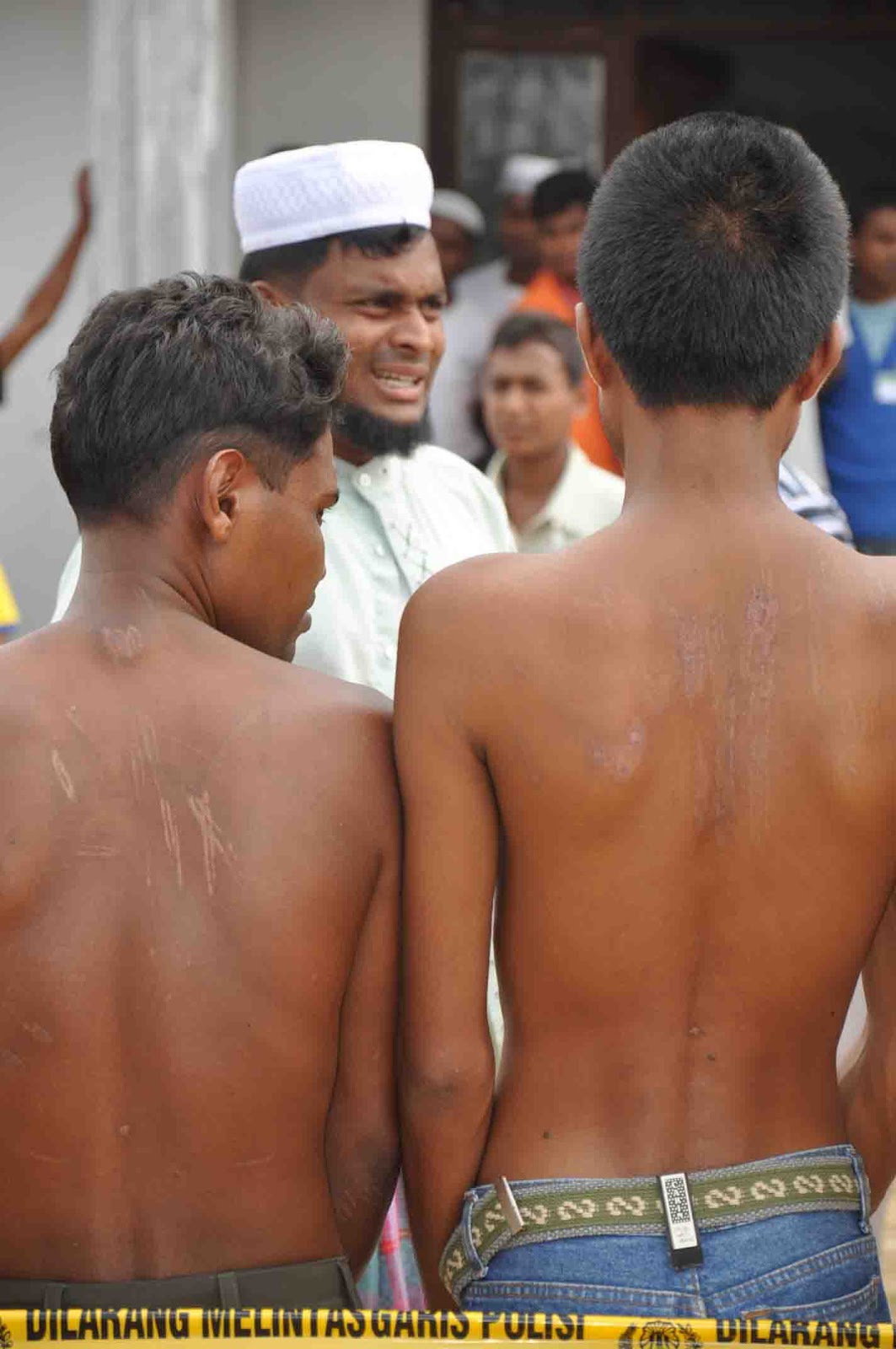 |
| Young Arakanese traces of torture |
On the other hand, neither Taylan
d nor has the international community taken any initiative to address the inhumane actions of the Myanmar authorities. In fact, while the refugees were hosted by the authorities and people of Aceh for more than a year, neither the Organization of the Islamic Conference nor any other Islamic organization provided comprehensive assistance, nor initiatives were launched to address the problem. The dramatic part of the matter is that while the Governor of Aceh, Irvandi Yusuf, stated that he would gladly accept the refugees into Aceh, the OIC member Indonesian authorities, far from supporting this view, spent nearly a year working on the status of the refugees. Considering the above-mentioned official statement of the OIC Secretary General, it is the right of all concerned to know what kind of roadmap the OIC has to tackle the problems faced by the Rohingya Muslims. Experts say that there is a lack of coordination within the OIC and that two important member states, namely Bangladesh and Indonesia, are not sensitive enough to take care of Muslim refugees.
d nor has the international community taken any initiative to address the inhumane actions of the Myanmar authorities. In fact, while the refugees were hosted by the authorities and people of Aceh for more than a year, neither the Organization of the Islamic Conference nor any other Islamic organization provided comprehensive assistance, nor initiatives were launched to address the problem. The dramatic part of the matter is that while the Governor of Aceh, Irvandi Yusuf, stated that he would gladly accept the refugees into Aceh, the OIC member Indonesian authorities, far from supporting this view, spent nearly a year working on the status of the refugees. Considering the above-mentioned official statement of the OIC Secretary General, it is the right of all concerned to know what kind of roadmap the OIC has to tackle the problems faced by the Rohingya Muslims. Experts say that there is a lack of coordination within the OIC and that two important member states, namely Bangladesh and Indonesia, are not sensitive enough to take care of Muslim refugees.
In support of Lewa's views, it is worth sharing the following points. According to some Western sources, around 730,000 Rohingya Muslims in Rakhine State in the north of Myanmar, bordering the Bengal border, are trying to survive against the oppression of the dictatorial regime with the efforts of international aid organizations, especially the UN High Commissioner for Refugees. But on the other hand, the Myanmar government continues to make it difficult for UN staff to enter the country. Among the things the OIC can do is to follow up on the Secretary-General's words. Following this, the problems of the Arakanese Muslim refugees in Malaysia, Bangladesh and Thailand should be dealt with directly instead of referring them to the UN. Does the OIC, which is said to be undergoing a reform process, have the capacity to do this? According to what we have heard from leading officials of the organization, such a capacity does not seem to exist. But the situation is not hopeless. A "consortium" of serious aid agencies and human rights organizations operating in Islamic countries can and should address the issue with serious planning. On the other hand, the fact that at least some of the junta regime's bank accounts are in Dubai banks indicates that there is something that can be done economically and politically.
http://www.dunyabulteni.net/index.php?aType=haber&ArticleID=135942&q=%C3%96ZAY
English and Indonesian versions translated with DeepL AI


